
Element 1.2
1.2 Safety Accountabilities and responsibilities

Personnel must be accountable, accept responsibility and lead by example. If the workforce perceive management are not committed to safety, the safety culture is jeopardised.
Tasking and duties may be delegated, responsibility and accountability may not. Management are held legally and ethically responsible for the safety of employees.
The roles, responsibilities and accountabilities for personnel needs to be explicitly outlined in the SMS manual.
Demonstrating accountability
Management demonstrate accountability to safety by:
- Actively supporting and promoting the SMS
- Ensuring they and their staff comply with SMS process and procedure
- Ensure resources are available to achieve SMS outcomes
- Continually monitor their area of responsibility for SMS compliance.
The key personnel will include:
- The CEO
- Head of flying and/or maintenance operations
- Head of check and training
- Safety manager
- Others as required, possibly including;
- General manager
- Head of ground servicing
- Head of Cabin safety
- Head of administration services.
The safety manager (SM) must have direct access to the CEO (if required) for all matters relating to safety. This needs to be independent of any operational matters, and regardless of the position within the organisational structure. All other personnel in the structure need to have documented roles and responsibilities with respect to safety.
In the example structure below, the safety manager is a secondary role for a senior pilot (This is an actual example from a mid sized organisation from 2010). In the modern SMS environment the SM would be a stand alone position reporting directly to the CEO.

Example of organisation safety structure.
(SRC – Safety Review Committee, SAG – Safety Action Group)
Safety Governance
Regardless of the size and complexity of an organisation, each group/section/work area in an organisation needs to explore respective hazards, risks and general safety issues.
Where practical, there should also be larger safety meetings, perhaps including all staff at forums such as safety stand down days, the weekly/monthly CEO address or even an agenda item at the regular company BBQ. The aim it to have safety infused into the way of doing business and different organisations will have different flavours on how this should be achieved. These are all part of SMS process and should be documented in the SMS manual.
SMS also requires minuted meetings to discuss operational safety issues, Generally there would be a high level Safety committee – Safety Review Board (SRB) or Safety Review Committee (SRC) – to consider strategic direction with respect to safety, and formally review SMS policy and procedures. There would also be working groups – such as a Safety Action Group (SAG) – a lower level working group to consider more operational aspects of safety. The two must interlink.
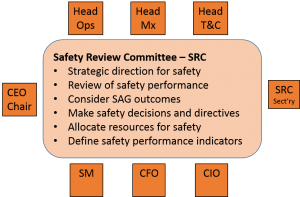
Safety Review Committee (or Safety Review Board) – SRC
The SRC is a high level safety forum made up of senior management. It provides strategic review as to the ‘overall safety health’ of the organisation. The terms of reference for the SRC will be outlined in the SMS manual and the outcomes from the meetings made transparent to the workforce.
As the accountable manager, the CEO would normally chair this meeting. However, if this task is delegated, the CEO remains the accountable manager. Other members of the SRC would include heads of departments.
The role of the SRC is:
- making recommendations or decisions concerning safety policy and objectives;
- defining safety performance indicators and setting safety performance targets for the organisation,
- Review safety performance and outcomes (generally this will be reported from the SAG);
- provide strategic directions to departmental SAGs – if established; and
- directing and monitoring the initial SMS implementation process
Note that the SRC must interact with the SAG. it will review outcomes and issues from the SAG and provide directives in response.
For example; the SAG may have raised an issue from a safety survey that employees felt a new SMS procedure was not well known. The SRC may direct the SAG to conduct further company wide training, committing both time and resources to rectify this.
Safety Action Group – SAG
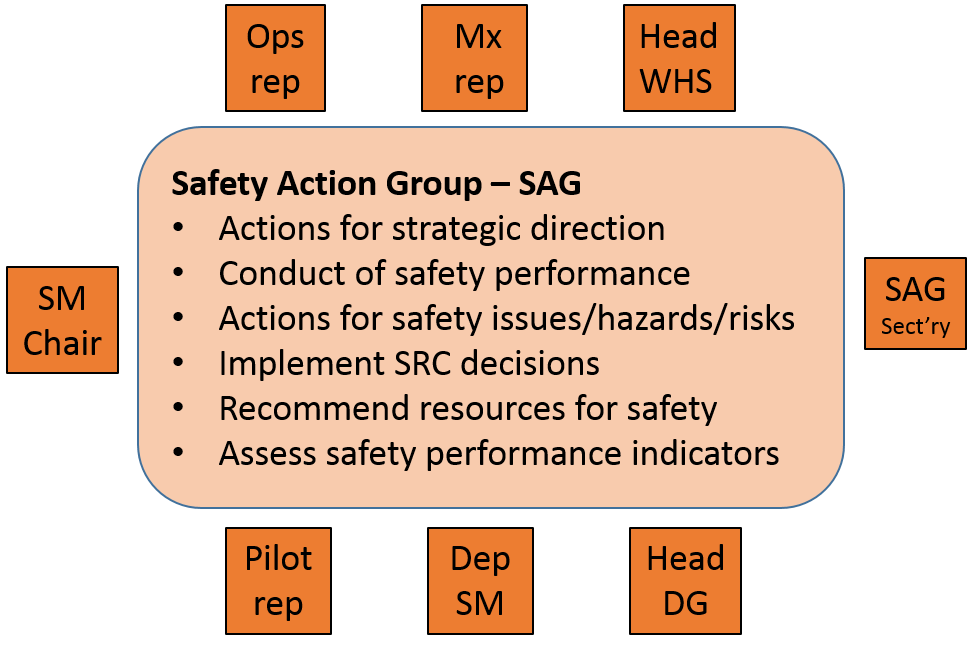
The SAG is a working group (or groups) – it gets actions done. An organisation may have multiple SAGs per departments. Each organisation must have at least one SAG and in many cases this would be sufficient.
Membership of the SAG is not an exclusive club. Management should encourage participation to any employee willing to contribute. Rotating participation is an opportunity to enhance different perspectives. The SM will have active involvement in SAG meetings.
The role of the SAG is:
- Overseeing the operational safety within the functional area;
- managing the area’s hazard identification activities;
- implementing mitigation or corrective actions relevant to the area;
- assessing the impact of safety on operational changes and activating hazard analysis as appropriate;
- maintaining and review of relevant performance indicators; and
- managing safety training and promotion activities within the area
Frequency of the SAG meetings must be defined in the SMS manual. If there are various other safety meeting where outcomes are fed into the SAG, quarterly is a recommended frequency. However if the SAG is the primary safety meeting in an organisation then perhaps monthly is more appropriate.
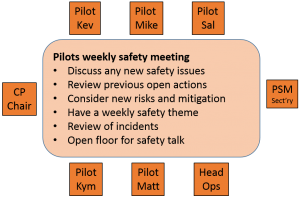
Other safety meetings
Each functional area should be having safety meetings. These can be as informal as management dictate. They could in the form of;
- ‘Smoko room’ discussions
- Tool box talks
- Crew room gatherings
- etc
The forum is not critical so long as they are regular, the purpose is to discuss issues of safety, and there is some documentation to record the events, outcomes and actions. These should be fed into the SAG for consideration.
Clearly a small non-complex organisation should not be forming working groups and committees where the number of people required on them are greater than the number of employees. Or perhaps the non-complexity of activities simply does not warrant diversifying the groups.
If this is the case, it may be much more appropriate to simply have combined meetings (perhaps with all employees) which document the different levels of SMS consideration, while demarcating;
- Functional area safety meetings;
- from safety actions (SAG activities);
- from strategic decisions on organisational safety (SRC activities)